
The project triangle
Finding the balance between scope, costs and time
Digitalization, artificial intelligence, sustainability, and new regulatory requirements are forcing companies to constantly adapt and change. To remain competitive, new projects are therefore continuously being launched. The goal is to make processes more efficient, introduce new technologies, or further develop products. However, as the number of projects increases, so does their complexity. Different teams work in parallel on related topics, key personnel are involved in multiple projects at the same time, and decisions made in one project have immediate repercussions on others. Despite professional project management, there is therefore a high risk that deadlines will be missed, resources will become scarce, and the expected benefits of strategic initiatives will fall short of expectations.
The cause of this often lies not in the quality of individual projects. Rather, there is a lack of an overarching view of interrelationships, dependencies, and shared goals. Program management provides the framework for managing multiple interconnected projects in such a way that, together, they achieve the desired strategic benefits.
What is the project triangle?
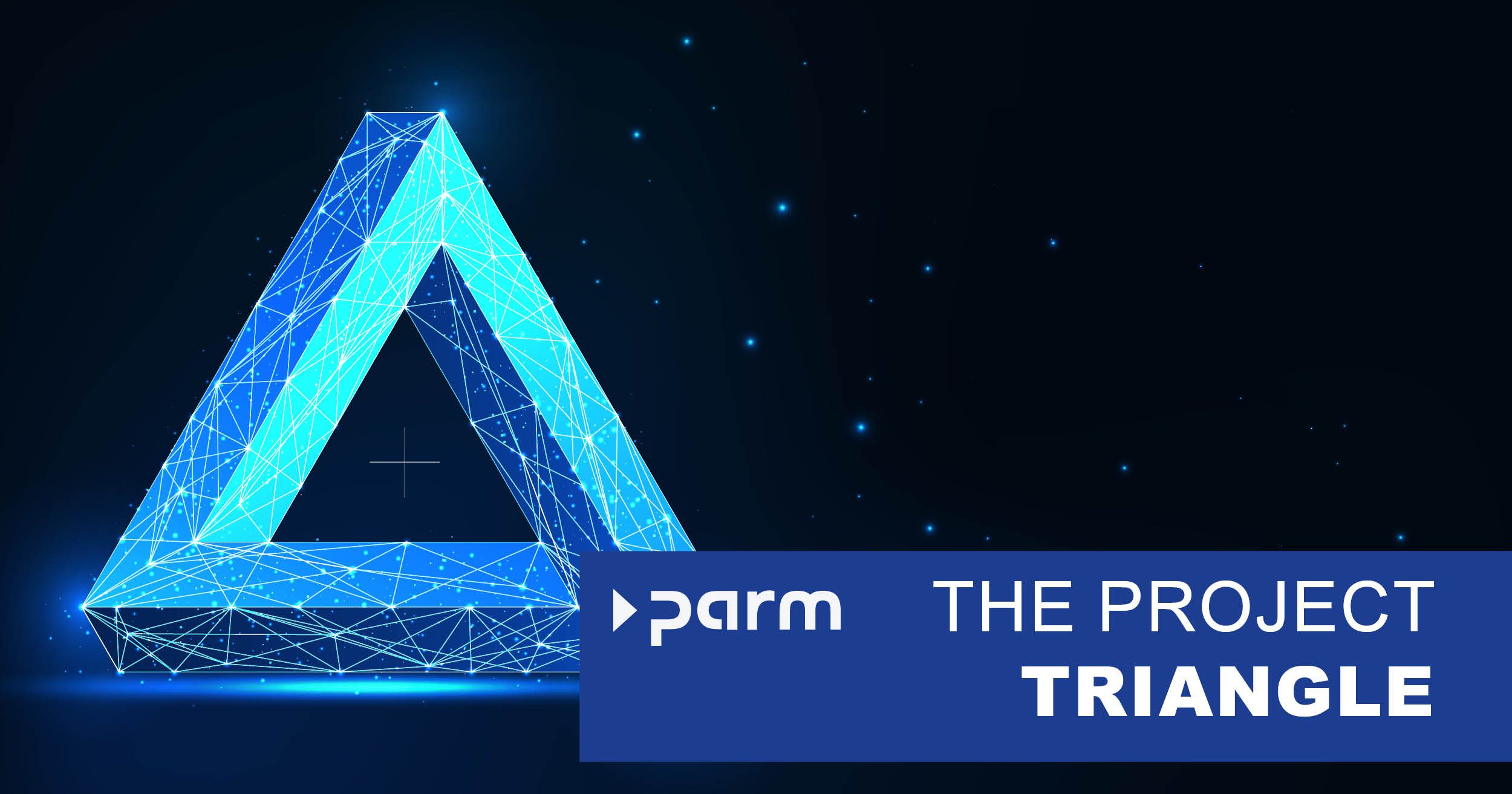
In classical project management, the three key factors—scope, time, and cost—are defined, and project management is then structured based on them. By forming the “magic triangle” between these three dimensions, we can see how they are interconnected and, consequently, the need to balance these three dimensions in order to successfully complete a project. This makes it clear that a change in one of the variables simultaneously triggers changes in the other two dimensions to keep the triangle intact. A project manager’s task, therefore, is to balance all three dimensions so that the project stays within budget and on schedule and meets all performance specifications. This can be a difficult task, as the three dimensions usually compete with one another.
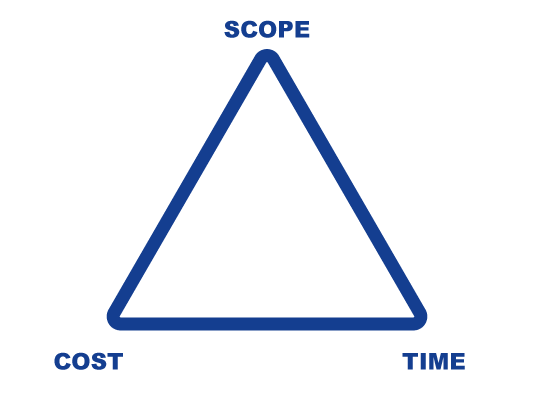
The three dimensions
To achieve an optimal balance among the three dimensions of the magic triangle, a project manager should have a deep understanding of how they can be influenced and where opportunities exist to adapt to changes as a project progresses. Therefore, it is important to understand the components that make up these dimensions.
1. Costs
This dimension includes not only the pure budget of a project, but also the available resources. This is because resources can be traced back to a financial value. For example, if additional staff is to support the project, if new equipment or additional rooms are needed, all of this will cause higher costs. Therefore, this point includes, among other things:
- The budget, i.e. the financial framework of the project
- The number of team members
- Available equipment and devices
- Available office space
2. Time
The dimension of time also goes beyond the mere duration of the project. Included are, among others:
- The project timetable as well as the number of project phases
- Hours worked on the project
- Time spent on planning and strategy
- Internal calendars and targets
3. Scope
The scope of a project includes both the scope of the project outcomes and their quality. In traditional project management, it is determined before the time frame as well as the budget. These include:
- Scope of work
- Level of detail of the final product, e.g. number and complexity of functions
- Quality of the results
- Quantity of end products or number of product developments
Our tip: In traditionally managed projects, “scope creep”—that is, an expansion of the scope of work without a corresponding adjustment to the budget or timeline—can occur over the course of a project. Therefore, it is important that the planned scope of work and its quality be documented and approved before the project begins. Every change should also be documented, and its implications analyzed. This ensures that changes can be approved, including with regard to budget and timeline.
How the three dimensions relate to each other
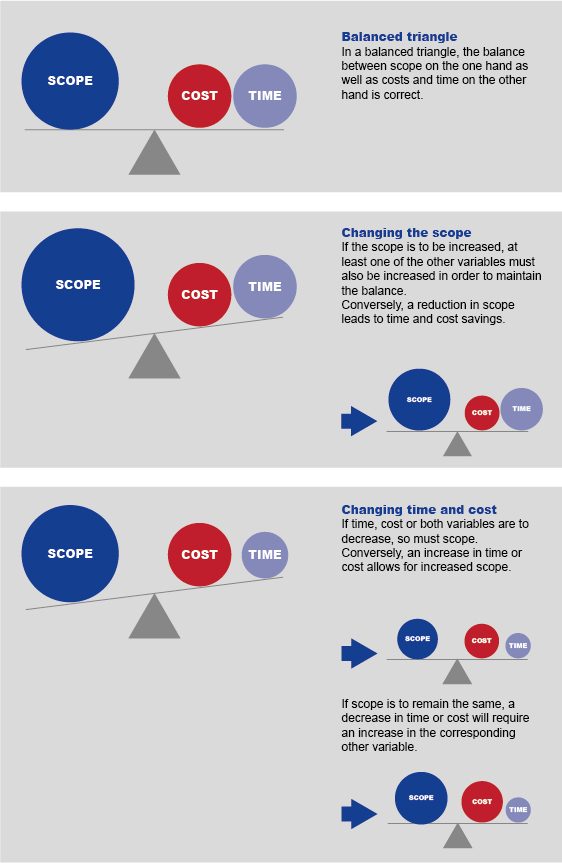
There are two different types of relationships in the project triangle. On the one hand, the relationship between the scope to be achieved and the other two variables is directly proportional. This means that scope moves in the same direction as time and cost. So if the scope of a project increases, for example because the volume is increased or the quality is improved, the available time and / or the costs must also be adjusted.
The relationship between costs and time, on the other hand, is inversely proportional, with the variables moving in opposite directions. Thus, if costs are to be reduced, time must be increased. If a project is to be completed more quickly, so the time dimension is reduced, the costs must increase.
This leads to the following insights:
How the magic triangle helps in project management
It is highly unlikely that none of the dimensions of the “magic triangle” will undergo changes during the course of a project’s implementation. Therefore, the central idea behind the concept is that a project cannot be successful if all three dimensions are rigidly fixed. To allow for some leeway for any necessary adjustments, at least one of these elements should be flexible. You should therefore choose your focus carefully and coordinate it with your project’s stakeholders. In this way, the Magic Triangle helps you with project planning and management, cost control, as well as risk management and change management. If the focus is on meeting the schedule, for example, it’s advisable to have an additional budget approved before the project starts to cover any necessary additional resources, or to clarify which deliverables are optional. If, on the other hand, your focus is on staying within budget, you should clearly communicate that the project deadline will need to be postponed or the scope of work reduced should unforeseen changes arise.
Our tip: To ensure clarity before the project begins and to know exactly how to proceed in the event of changes, you should document the most important points in the project charter (LINK: Project Documents) or project handbook. This includes:
- The client's preferences in case adjustments need to be made.
- Any pre-approved contingency budget
- A list of the most likely changes, as well as possible action plans for them, describing the impact on time, cost and scope.
During project implementation, keep all three dimensions in mind at all times so that you can react to changes at any time or think of measures to take if a change occurs.
Differences in traditional and agile project management
In traditional project management, it is assumed that the scope is fixed, as it is defined in terms of scope and quality, for example in the specifications. Costs and time are more flexible in this case. They are planned, but can change if necessary.
However, agile project management reverses this view so that costs and time are fixed, but performance is adjusted. This is because the iterative planning in Scrum, for example, uses so-called sprints in which the work is done. Their number or duration is usually fixed, which also makes the costs of a project easy to estimate. Thus, it is the scope that is variable.
Extensions of the project triangle
Today, it is often no longer sufficient to focus on just three dimensions in project management. Therefore, the dimension of scope is often subdivided into quality and content. This is referred to as the magic square or the devil's square.
The magic triangle can also be expanded to include the all-encompassing factor of customer satisfaction, which is about the satisfaction of all stakeholders. Since they usually have different demands on a project, it is important that the needs of all project stakeholders are addressed.
Conclusion
The project triangle is well suited for visualising the interrelationships of the most important factors in project management: time, costs and scope. It quickly becomes clear that these dimensions should be balanced and that a change in one dimension will result in a change in the other dimensions. A realistic assessment of all three factors at the beginning of the project as well as setting the right priorities and clear communication are therefore of high importance for the success of a project.
With project management software such as myPARM, you can keep an eye on all three dimensions at all times and thus take action if something changes in one dimension. Real-time reporting in dashboards with all the important key figures and an early warning system help you to do this. If changes occur in one of the dimensions, you can quickly see within the software how these changes affect the other factors and therefore how you can intervene.
Find out more about the myPARM project and portfolio management software:
Would you like to get to know myPARM in a demo? Then make an appointment with us right away!