

Selecting the optimal project method
Managing project portfolios with the Stacey Matrix
Agile project management methods are still in vogue. However, not every project can be carried out agilely, because the project management method applied should always fit the current situation, or the respective project, in order to unfold its full effect. Therefore, a hybrid approach or even a classic approach can make sense. However, deciding which method is best suited is not always easy. The Stacey Matrix can be used as an aid to decision-making and thus simplify project portfolio management.
What is the Stacey Matrix? The original
The Stacey Matrix goes back to the organisational theorist Ralph Douglas Stacey and was originally not used to select the right process model for upcoming projects, but rather to shed light on the topic of "decision-making in companies in complex situations" in general.
Stacey was primarily concerned with the following questions:
- What factors contribute to complexity in organisations?
- How can decisions be best made in uncertain situations?
- Which strategies are best suited for different complex situations?
To answer these questions visually, the Stacey matrix spans an area between two axes in which systems or projects are positioned according to their level of complexity.
- Y-axis: Level of agreement
This axis represents the degree of agreement among decision-makers—that is, how much they agree when making decisions. It also addresses the question of whether the goals or requirements to be achieved are clear or cannot be clearly described. The following applies: For any entry at the origin of the coordinate system, there is complete agreement; the further an entry is from the origin, the more divergent the decision-makers’ views are. - X-axis: Degree of certainty
This axis represents the dimension of certainty, that is, how confident decision-makers are regarding the decision. In other words, the farther the entry is from the origin, the greater the uncertainty regarding how the goals, requirements, or activities can be achieved, or which resources, methods, or tools can contribute to solving the problem.
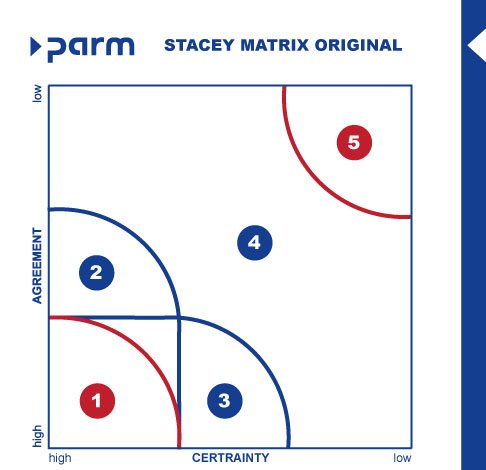
Stacey identified five fields to be considered individually, which dictate the respective type of decision-making:
1. Close to agreement and certainty: Entries in this area are particularly easy to implement because there is a high level of agreement and certainty. In such a case, best practices can be applied or lessons learned from the past can be used, for example.
2. Far from agreement, close to certainty: In this case, there is certainty about the procedure and the results. However, the decision-makers disagree So decisions have to be made through compromise or negotiation. As a result, decisions are more likely to be made at a political level.
3. Close to agreement, far from certainty: In this field, the agreement of the decision-makers is high, while the certainty is in the middle range. I.e. the decision-makers agree, but details of the course of action are unclear. In this case, decisions can be made on the basis of clear facts and analyses, or an expert can be brought in to increase certainty. A shared vision can also help in this area so that it is clear what state is being worked towards, even if the individual steps to get there are not yet known.
4. Complexity: Decisions that fall in this area are complex as both agreement and certainty are low. It is difficult to make a good choice in this area. Therefore, you should focus on creativity, innovation or root cause analysis. Experimentation can also be useful here if you can react quickly to changes.
5. Anarchy: There is neither agreement nor certainty in this field. Therefore, decision-making is not possible, as neither precise planning nor negotiation will help to reach a decision. Therefore, this area of the matrix should be avoided. A project in this field should be fundamentally reconsidered.
Stacey Matrix in project management
The new approach of the Stacey Matrix is a combination of the original Stacey Matrix and the Cynefin Framework. It combines decision-making in areas of varying complexity with a consideration of the environment of situations and projects.
Excursus: Cynefin
David J. Snowden developed the Cynefin Framework, which divides projects, problems and tasks into five different fields in order to simplify decision-making. These fields differ mainly in terms of the relationship between cause and effect. Snowden distinguished the fields simple, complicated, complex, chaotic and unclear.
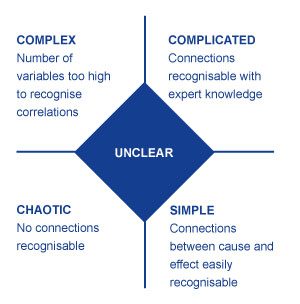
The new version of the Stacey Matrix therefore focuses not only on the complexity of a project, but also on the interactions between a system and its environment.
To illustrate this, two axes are used, along which the four Cynefin domains—simple, complicated, complex, and chaotic—are plotted.
- Y-axis: Requirements
This is where you indicate how clear and unambiguous the requirements are—that is, whether there is agreement on what needs to be implemented. - X-axis: Technology or Method
This axis indicates how requirements should be implemented, or how well the technology or method is understood for this purpose.
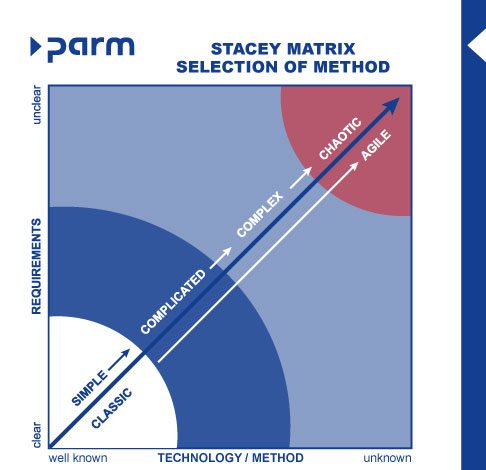
Levels of complexity and recommendations
Area 1: Simple
In this area, both the requirements and the solution path are known. These are usually routine tasks for which considerable experience already exists. Pre-built checklists, standard processes, or best practices can be used for a project in this area to achieve the goal.
Area 2: Complicated
A project is considered complex when there is slight to moderate ambiguity regarding the requirements and/or the solution approach. In complex situations, traditional project management can achieve excellent results – albeit with a different focus depending on the specific circumstances: Uncertainty regarding the requirements necessitates compromises and negotiations for decision-making. Uncertainty regarding the methodology can help identify the best solution.
3. Area: Complex
A project is considered complex when the requirements are very unclear and change frequently, and/or when the method for achieving the goal is unclear and unpredictable. Since projects in this area are constantly evolving, a meticulously planned approach is not very promising. Instead, an iterative approach should be used, employing an agile methodology that helps to gradually approach the goal. Hybrid methods can also be successfully applied in this area.
Area 4: Chaos
When requirements are completely unclear and methods are unknown, a project becomes chaotic. Planning is unlikely to succeed in such situations. Therefore, an agile approach is advisable in this area, allowing for a gradual, step-by-step approach that moves the project into the realm of complexity over time. Design Thinking can be particularly helpful in this context.
Advantages of the new Stacey Matrix
- Good support in choosing the right approach or project management method
- Simple, visual representation
- Can be used in communication with stakeholders
Disadvantages of the new Stacey matrix
- Does not take into account the project environment
- Boundaries between the different areas are floating, therefore no exact information about the best method is feasible
- Two dimensions are not always sufficient to fully assess complex situations
Conclusion
The right project management method always depends on the situation, as each method has its strengths and weaknesses. Therefore, you should weigh up which method is most suitable before starting any project. The Stacey method can help you with this by allowing you to assess the project based on the clarity of the requirements, the familiarity of the methods to be used and the stability of the environment. In this way, the initial situation is visualised and the Stacey matrix provides clues for suitable methods. However, it is important to note that the Stacey Matrix can be misinterpreted and does not provide exact results. Therefore, you should also rely on your experience and that of your team as well as look for good tools such as the project management software myPARM to support you in the implementation of your projects - regardless of whether you choose a classic, hybrid or agile approach.
Find out more about the myPARM project and portfolio management software:
Would you like to get to know myPARM in a demo? Then make an appointment with us right away!