
Feasibility Study
Here’s how a feasibility study can help you avoid bad investments and select the right projects
A comprehensive, complex project is always very exciting. On the one hand, carrying it out promises great success; on the other hand, however, there is also a high level of risk—for example, because a significant amount of money and time must be invested in the project. Before a manager approves such a large project, they should therefore request a feasibility study.
What is a feasibility study?
A feasibility study is conducted before a project begins. It is used to determine whether a project has a good chance of success and whether it is beneficial for the company. Therefore, it is an important factor in deciding whether to proceed with a project.
The feasibility study therefore answers the questions:
- Does the company or team have all the necessary means and resources to successfully complete the project?
- Is it worthwhile for the company to pursue the project idea further?
As part of the feasibility study, various potential projects and solutions are analyzed and evaluated. The opportunities and risks associated with each project are also documented, and the likelihood of success is assessed, so that a specific recommendation can be made for each project as to whether it should be implemented or not.
When should a feasibility study be conducted?
Feasibility studies are particularly helpful for projects that require significant investment, as they reduce the likelihood of allocating important resources to the wrong projects.
Useful if:
- To reduce bad investments
- to identify the optimal solution or narrow down possible alternatives
- to identify risks and vulnerabilities
- to assess the market situation before the project begins
Not appropriate if:
- a project is only small in scope
- you already know that the project is feasible
- Competitors are already successful with a similar project
Prerequisites:
A prerequisite for the study is having specific project goals, since a study cannot be conducted without specific objectives. In addition, you should have a clear understanding of the project's framework conditions.
Components of the feasibility study
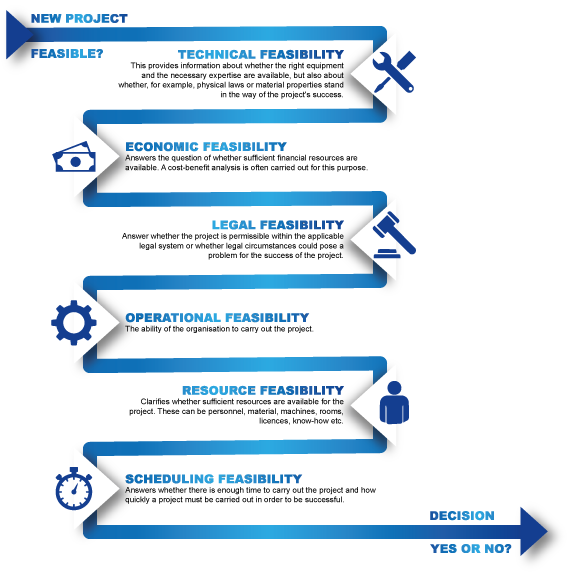
-
Technical Feasibility: This refers to feasibility from a technical perspective; that is, technical feasibility determines whether the right equipment and necessary expertise are available, but also whether, for example, the laws of physics or material properties stand in the way of the project’s success.
Do we have the technical capabilities to carry out the project, or what is needed to make it possible? -
Economic Feasibility: Determines whether sufficient financial resources are available. A cost-benefit analysis is often conducted for this purpose.
Do we have the necessary budget to carry out the project, and is it worth it? If not, how can we secure funding, reduce costs, or make the project profitable? -
Legal Feasibility: Determines whether the project is permissible under the current legal framework or whether legal considerations could pose a problem for the project’s success.
Are we permitted to carry out the project, or would changes need to be made to ensure compliance with laws, regulations, or guidelines? -
Organizational Feasibility: The company’s ability to carry out the project.
Can the project be carried out with the existing team, or will additional staff need to be hired? Do we have the necessary skills, authority, and responsibilities, and is our project management maturity level sufficient? -
Resource-Based Feasibility: Determines whether sufficient resources are available for the project. These may include personnel, materials, machinery, space, licenses, expertise, etc.
Do we have sufficient resources? If not, can we obtain them? What would that cost? How long would it take? -
Time Feasibility: Determines whether there is sufficient time available to carry out the project.
Do we have enough time to carry out the project? Are the deadlines realistic?
Contents of a feasibility study
To conduct a feasibility study, you have countless options, information sources, and tools at your disposal. These include, for example, SWOT analyses, risk analyses, cost-benefit analyses, utility analyses, and economic feasibility analyses. You can also incorporate surveys, interviews, competitive analyses, scenario planning, or even social media trends into your study. Since every project is different, you’ll need to weigh which options are most appropriate. However, the content of a feasibility study is similar in most cases:
1. Preliminary analysis
Since conducting a feasibility study is very time-consuming, you should first determine whether there are any obvious, insurmountable obstacles that would make a feasibility study unnecessary. If major obstacles are apparent from the outset, a feasibility analysis is probably not worth the effort.
2. Project scope
To define the scope and objectives of the feasibility study, you should first describe the scope of the project. At this point, also define the criteria by which the project’s feasibility will be assessed. In this phase, you will also clarify the technical, organizational, resource-related, and time-related feasibility of the project, for example, based on an initial project plan.
3. Financial assessment
Gather information on the expected income and costs of the project so that you can assess its economic feasibility.
4. Market analysis
Market analysis helps you understand the market demand for the project’s deliverable and whether there are any legal obstacles. It also helps you understand what revenue you can expect, what risks exist, and whether there is any demand at all for your product or service. In addition, during this phase, you’ll gather information about the potential target audience and the competitive landscape. You can also analyze potential marketing strategies at this stage.
5. Alternative solutions
If you encounter potential problems or identify weaknesses during the analysis, you can seek out and evaluate alternative solutions. This may allow you to find alternatives that will still enable the project to be carried out successfully.
6. Evaluate the results
Examine the results objectively and holistically. Are the various solutions feasible? What risks are involved in each case?
7. Decision
At the conclusion of a feasibility study, recommendations are made regarding the next steps. This includes deciding whether or not the project should be carried out. And if it should be carried out, which approach is best.
Advantages
- Comprehensive assessment of a project's feasibility
- Identifying alternative solutions
- Identifying risks or obstacles
- Basis for deciding whether to proceed with or abandon a project
- Prevents misguided investments
- Highlights the market situation
- The information gathered helps with the subsequent implementation of the project
Disadvantages
- Very time-consuming
- Costly
Conclusion
A feasibility study is a useful tool for preventing poor investment decisions and selecting the right projects. It also helps with planning and executing projects by identifying risks and obstacles, as well as alternative solutions.
Feasibility studies are often not conducted due to time constraints and the associated costs. However, project managers should always conduct at least a small, basic analysis, since the costs incurred when a project is launched and then found to be unfeasible can be much higher than the cost of the analysis itself.
Good project management software can help you conduct a feasibility analysis. Through project planning, the software can provide valuable information on temporal feasibility, as well as organizational and resource-related feasibility. It also helps you understand economic feasibility, as it enables you to estimate the project costs. Project management software with integrated portfolio and program management—featuring customizable scorecards as well as risk and opportunity analysis—also helps you decide which projects to pursue.
Find out more about the myPARM project and portfolio management software:
Would you like to get to know myPARM in a demo? Then make an appointment with us right away!