


A Simple Method for Costing, Pricing, and Controlling
In an interview, Richard Lammers explains a new management method

How successful are projects really? Richard Lammers, a management consultant at MSB Management-Service-Beratungsgesellschaft mbH, asked himself this question. But it’s often difficult to provide a quick answer to such an important question. To simplify this, he developed the Lammers Quotient. In an interview with Parm AG, Lammers explains the background.
Parm: Mr. Lammers, what inspired you to develop the Lammers Quotient?
Richard Lammers: As a management consultant, I spent many years working on corporate management tasks and implemented numerous projects in the areas of business planning, cost estimation, and controlling. In the process, I repeatedly noticed how much time is spent providing business plans with the necessary target-actual comparisons. Furthermore, cost estimates and pricing are often based on outdated data, and employees sometimes use different pricing models as well as software with varying cost calculation methods.

This approach not only makes pricing opaque, but also makes it difficult for management to determine whether an order is profitable. To enable not only management but also employees to make more economically sound decisions, I developed the Lammers Quotient.
P: Many companies use markup calculations as the basis for pricing. Where do you see the weaknesses in this approach?
L: For one thing, purchase prices change quite quickly, which means that the cost of materials and goods is often variable. This poses the risk that, on the one hand, prices might be set too low, so that an order does not generate enough profit. On the other hand, prices could also be set too high, which could result in losing orders that are actually profitable.
P: Have you often experienced such situations?
L: Yes, especially when a contract with very high revenue is on the horizon. Without a sufficient basis for analysis and evaluation, this can result in losses on the income statement or even lead to corporate insolvency. This is usually because, in such cases, too many employee hours or resources are allocated to unprofitable projects, leaving a shortage of those resources elsewhere for more profitable projects.
P: How can the Lammers Quotient help with this dilemma?
L: The Lammers Ratio combines the contribution margin with capacity utilization into a single metric. Its core elements are, on the one hand, available service hours and, on the other hand, a company-specific interpretation of orders. This allows the profitability of an order to be calculated and visualized.
P: What exactly does the result of this calculation mean?
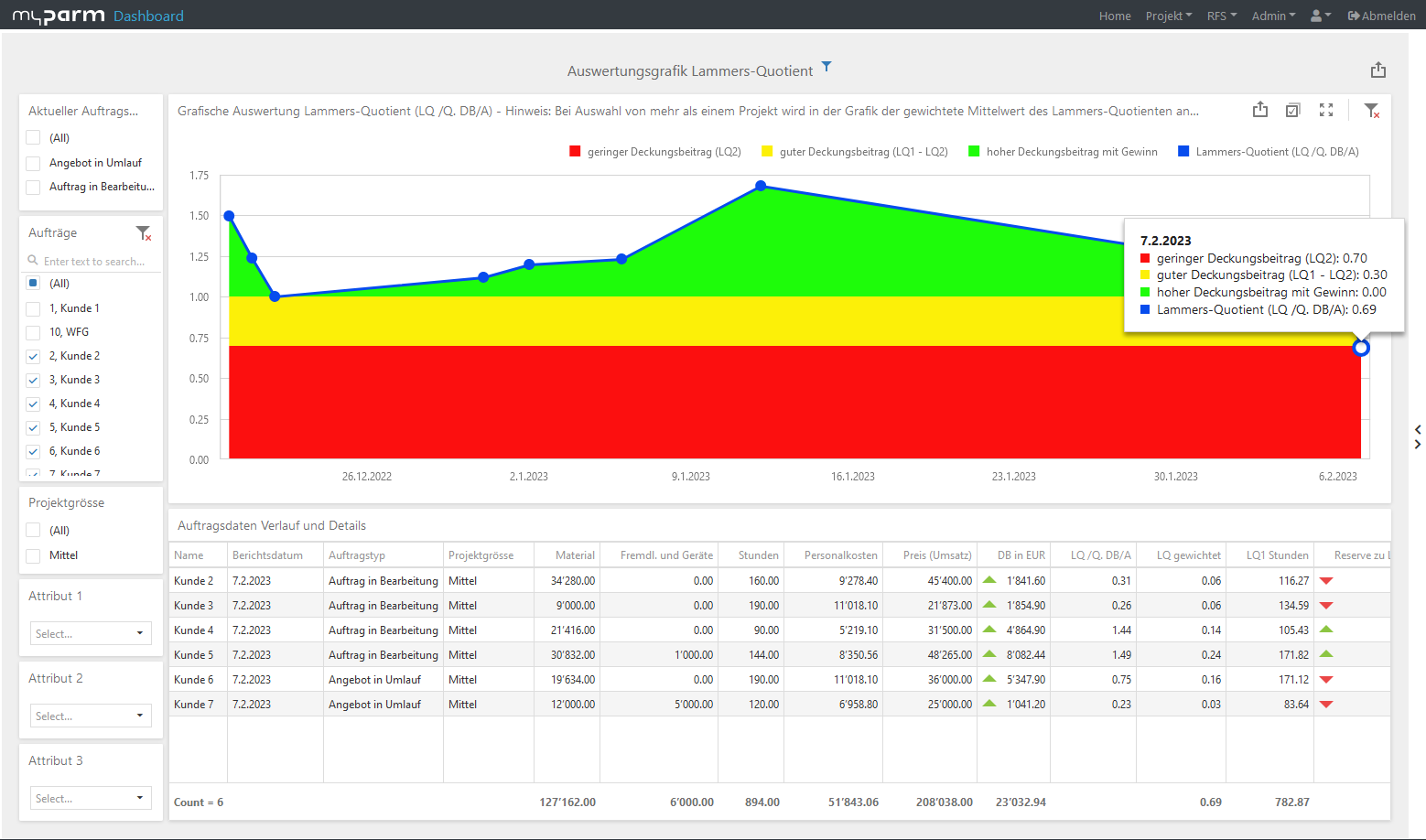
L: The rule of thumb is simple: Values above 1 are good—that is, orders in this range have a high contribution margin and high profit margins. Values below 1, on the other hand, are not good. To obtain more precise insights, this range is further subdivided, although the standard threshold of 0.75 can be adjusted depending on the company’s specific approach. Values in the upper range indicate orders with a high contribution margin and low profit margins, while values below the threshold indicate that an order has a low contribution margin.
P: You've tested the Lammers quotient at various companies. What was your experience with it?
L: It has been shown that cost estimates for short- and medium-term projects generally have a solid basis, but long-term projects with a high proportion of labor costs often slip into a range below 0.75. The Lammers Quotient can be used to calculate the number of employee hours at which a project leaves the healthy “green” zone or even slips from the “yellow” into the “red” zone. This makes it easy to identify at what point such projects are no longer profitable.
However, I’ve also noticed that it’s important to take a close look at the green zone. It’s not uncommon for the values here to be as high as 5 or 6. In such cases, it’s important to ensure that customers remain willing to pay those prices. It is therefore worth paying special attention to customer satisfaction in such projects in order to remain profitable in the future.
P: What key figures are needed to calculate the Lammers quotient?
L: In addition to the data required for a standard cost estimate, you only need a budgeted cost statement for the coming or current year that includes employees’ budgeted hours. In other words, to determine prices, you need the costs of materials and goods, external services, machinery and equipment costs, as well as the employee hours worked on a project. For orders in the order backlog or in progress, you’ll also need the revenue or work-in-progress status. Once you enter these five figures, the Lammers Quotient immediately shows you which orders are disproportionately profitable and which are not.
P: What can you do with the knowledge gained in this way?
L: First, you can prioritize orders or projects and work toward eliminating those in the red zone or no longer accepting them. This allows you to have your employees work on orders that have a high contribution margin and profit share. In my experience, this approach has increased the profitability of the order backlog by between 10 and 50 percent.
The Lammers Quotient can thus provide important insights for a company, help determine optimal prices, highlight calculation errors, and serve as an early indicator of project profitability.
Thank you very much for the interview!
Conclusion
Would you like to test the Lammers Quotient and use it in your company? In cooperation with Parm AG, the myPARM LQ ProfitGuard software was developed specifically for this metric; it can quickly and easily evaluate quotes and orders, regardless of whether they are quotes currently in circulation, orders on hand, in progress, or even completed orders. To help you immediately translate insights into action, a task management system with a Kanban board is integrated. The additional document management feature allows you to store all important information in a single system.
Learn more about the new myPARM LQ ProfitGuard software:
Would you like to learn more about myPARM LQ ProfitGuard through a demo? Then schedule an appointment with us today!