
Project Management ABC: H for Hybrid Project Management
The Best of Both Worlds

Traditional project management follows a clear structure and a precise plan in which all the steps to be taken are defined individually from the very beginning. Anyone familiar with such a plan can confidently work toward their goal. However, it is sometimes necessary to be able to react flexibly—for example, when the goal to be achieved cannot be precisely defined at the start of a project. In such cases, agile methods asked. But why shouldn't there be a method that combines both approaches—one that has a precise plan yet remains flexible? That's hybrid project management.
Hybrid project management is the combination of different project management methods or the use of individual elements from various project management approaches. The goal here is to leverage the advantages of the different approaches and avoid their respective disadvantages. In most cases, the term “hybrid” refers to a combination of traditional and agile methods. However, there are also combinations of different agile approaches—such as when Scrumban is used—or of different traditional approaches, such as when project planning with PRINCE2 is supplemented by a waterfall system.
Objectives
A project manager’s goal is to achieve the best possible project outcome: projects should be completed by the planned deadline and within the planned budget, the result should be satisfactory to the client, and teamwork should run smoothly. At the same time, traceability, documentation, and security often need to be taken into account. As a result, most companies have developed—or even adopted—a certain methodology over time. Hybrid project management can help meet these various requirements while simultaneously utilizing useful elements from different approaches, tailored to the specific needs of each project. This allows organizations to benefit from the advantages of various approaches, leading to better results and the achievement of project goals at a lower cost.
A Combination of Traditional and Agile Project Management
Hybrid project management is generally understood to mean a combination of traditional and agile methods. This means, for example, that a project managed using traditional methods is supplemented with agile methods for specific tasks. The goal is to prevent employees from becoming overburdened and to ensure that priorities and responsibilities are clearly defined.
Advantages of classic project management:
- Fixed, familiar structures
- Planning certainty
- Continuity
- Attention to detail
- Defined tasks and responsibilities
Disadvantages of classic project management:
- Little flexibility
Advantages of agile project management:
- Flexible and dynamic
- Fast
- Communication on an equal footing
- Regular, prompt feedback, leading to rapid improvements
Disadvantages of agile project management:
- High Complexity
- Working in a fully agile manner is not possible in many companies
- Lack of documentation
Roles in hybrid project management
In traditional projects, the project manager is responsible for planning and execution—and thus for the project’s success. In agile projects, however, the role of project manager does not exist. Instead, in Scrum, for example, there is a Product Owner who combines product and project management tasks, among other things, and a Scrum Master who is responsible for ensuring the process is followed. While the project manager is in charge of the project team, neither the Product Owner nor the Scrum Master holds this position. Rather, in agile projects, the development team is responsible. Since both approaches have such different roles and responsibilities, while all roles from the various approaches may be represented in a single project, roles, tasks, and responsibilities should be precisely defined at the start of a hybrid project to prevent misunderstandings.
Frequently used approaches
There are various ways to implement hybrid project management. On the one hand, different methods can be used in parallel. This means, for example, that some departments generally work using traditional methods, while others use agile methods. It can also mean that individual projects or parts of projects are generally carried out using traditional or agile methods. Alternatively, the methods can be blended—for example, by combining traditional project planning with agile sprints. Here are some methods that are frequently used:
1. Water-Scrum-Fall:
Work packages, costs, and project deadlines are planned using the traditional waterfall method. The work packages to be completed are then handled using Scrum methods. This provides greater flexibility than in traditional projects.
2. Critical Chain Scrumban:
The project is planned using the Critical Chain method from traditional project management. Individual work packages are then completed using an agile approach that combines Scrum and Kanban boards. The critical path, which includes key milestones, allows for accurate estimates of project duration and resource requirements. At the same time, the agile work packages enable projects to be completed more quickly using this method.
3. Scrumban:
This approach combines the agile methods of Scrum and Kanban, making it ideally suited for product development. It uses a Kanban board with the Scrum process. The resulting Scrumban boards provide a clear overview of the workflow while optimizing processes.
How does hybrid project management work?
To determine the right combination of methods for your project, you can proceed as follows:
1. Define requirements
First determine what the requirements are, i.e. what is needed in the context of the project and what goals are to be achieved.
2. Define methods
The first step will help you determine which methods best suit your requirements and goals, as well as your project team. In this step, you should also define roles, tasks, and responsibilities.
3. Test the methods in a pilot project
If you want to make sure that the selected combination of methods actually works optimally, you can test it in a pilot project. This can also be a hypothetical scenario. The important thing is that you are able to analyze and evaluate the selected methods.
4. Evaluate and adapt methods during application
Hybrid project management thrives on its ability to be customized to specific needs. You should take advantage of this opportunity throughout the project by regularly checking whether the methods are working as intended and, if necessary, replacing or adapting them. This will help you continuously improve your project work.
Advantages
- The project structure can consist of various combinations of methods and can therefore be customized to the specific company and project. This enables the creation of tailored solutions.
- Ability to respond quickly to new situations while maintaining planning certainty
- The project’s goal remains the focus of all activities at all times
- Communication among project team members is improved
- Applicable to all projects—regardless of requirements, size, complexity, industry, etc.
Challenges
- Employees’ knowledge and expertise are necessary across all approaches and methods
- It takes more time to identify the right combination of methods before the project begins
- Responsibilities, roles, and tasks should be clarified at the start of the project to avoid misunderstandings and problems
- More complex to implement compared to using only traditional or agile methods
Practical tips
1. Start slowly
Your traditional project management works well, but you’d like to supplement it with agile methods? Then start slowly by integrating agile techniques. This way, you and your project team will learn how to handle the more complex hybrid project management approach and can try out the various methods at your own pace.
2. Train project team members in both methods
Many project team members are well-versed in either traditional or agile methodologies. However, to get the most out of hybrid project management, they should have extensive knowledge and experience in both areas. Therefore, train your staff in the various methodologies.
3. Experiment
Every company and every project is unique. Therefore, individual methods may not always work equally well. So be bold and open to experimentation, so that you can decide at any time which methods are best suited to the tasks at hand.
Conclusion
Every company is unique, and not every method is suitable for every business environment. That’s why every company, every department, and every project needs its own customized hybrid project management approach. However, with a deep understanding of both the stakeholders and the project team, it’s possible to find the right combination for every company and project—one that will improve your project work.
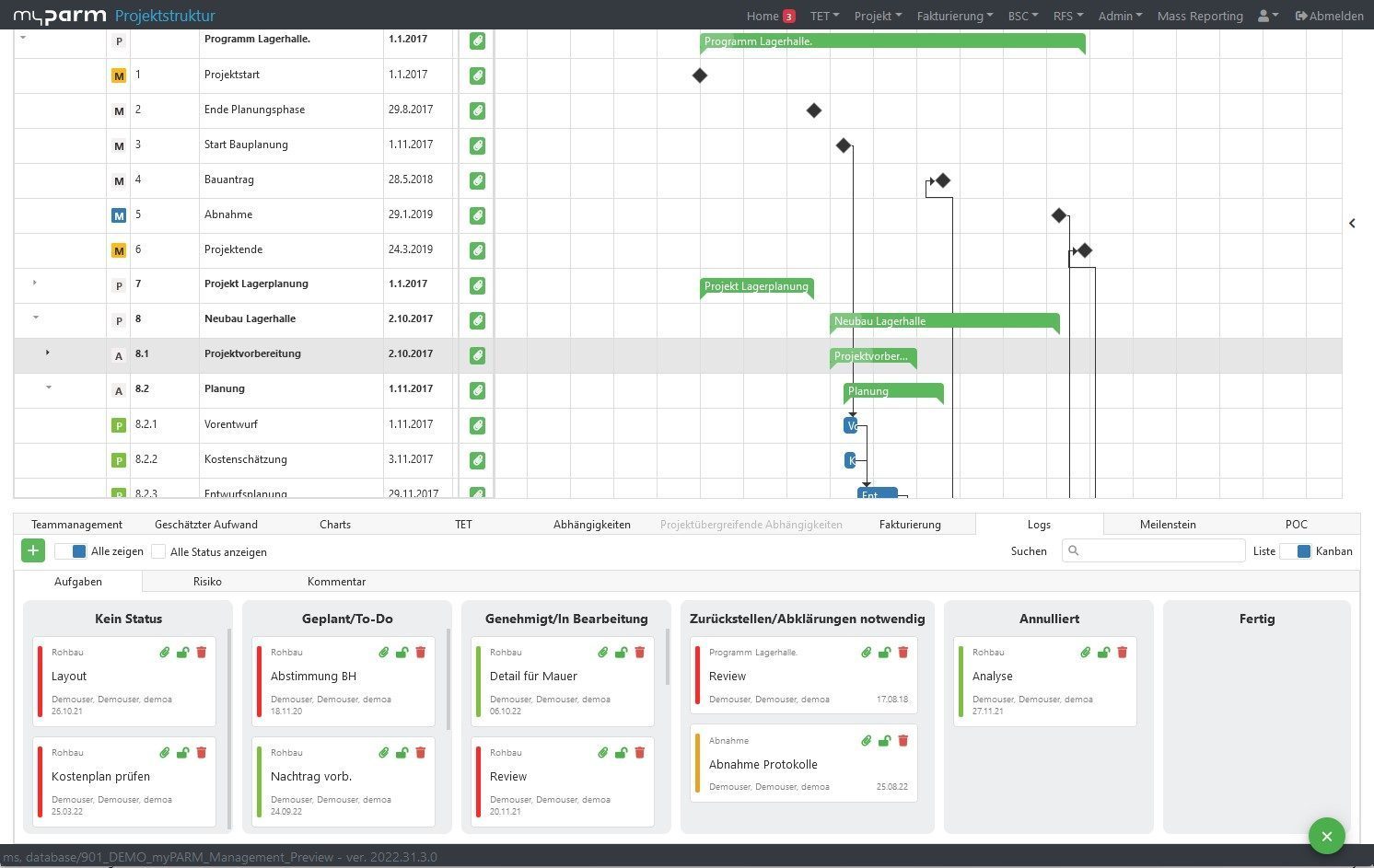
Flexible project management software can support you in the application of classic, agile and also hybrid project methods, for example by carrying out classic project planning with a Gantt chart, but then planning the individual tasks with a Kanban board.
More about the project management software myPARM:
Would you like to get to know myPARM in a demo? Then make an appointment with us right away!