



Crisis Management Under the Christmas Tree
When the gift doesn't arrive on time and other disasters strike
Christmas is a time of joy and harmony – at least in theory. In practice, the holidays often present challenges in organization, communication, and problem-solving. Especially when, to make matters worse, something goes wrong: The present doesn't arrive, the fairy lights are broken, or the main meal is a charred disaster. These scenarios are similar to the crises we can encounter professionally in project management. But don't panic: With the right strategies, every Christmas and project situation can be saved!
Scenario 1: "The gift doesn't arrive - delivery delay in Christmas chaos"
The incident: Weihnachten kommt wie eigentlich jedes Jahr ganz plötzlich und die neue Spielekonsole für das Kind wurde noch nicht gekauft. Leider ist sie im lokalen Handel ausverkauft, aber das ist heutzutage natürlich kein Problem mehr.
The perfect plan: Order the console, and it should be delivered in time for December 24.
The reality: The package is stuck in a distribution center for days, and the tracking status remains stuck at “in progress.” By the morning of December 24, at the latest, if the tracking status hasn’t changed, it becomes clear that the package won’t make it to you in time for the gift-giving.
In project management, delivery delays are among the most common problems. Whether it’s a shortage of materials or external service providers failing to deliver on time, such obstacles can throw the entire schedule off track.
The solution:
- Have a plan B ready: With the high volume of parcels around Christmas, it's understandable that individual deliveries can run into difficulties. If you think about this in advance, you can get an alternative gift to defuse the situation. Were you hoping until the last minute that the game console would still arrive? Then why not give your child a game for the console with a humorous message such as: "Christmas miracle guaranteed to arrive on 28.12!" Such a plan B is certainly not ideal, but it can prevent major disappointments.
- Communication is everything: Even if you have a plan B, you should be open and honest at the latest when there are sad faces at the gift-giving. Children, spouses, parents-in-law, and customers appreciate it when you explain transparently why something didn't go as planned. You should therefore forgive them quickly with a sincere apology.
- Lessons learned: As unpleasant as such a scenario is, it should not happen to you again next year. Therefore, after the holidays, consider how such risks can be minimized in the future - be it through earlier orders or longer buffer times.
Scenario 2: "The Christmas tree falls over - when the foundations shake"
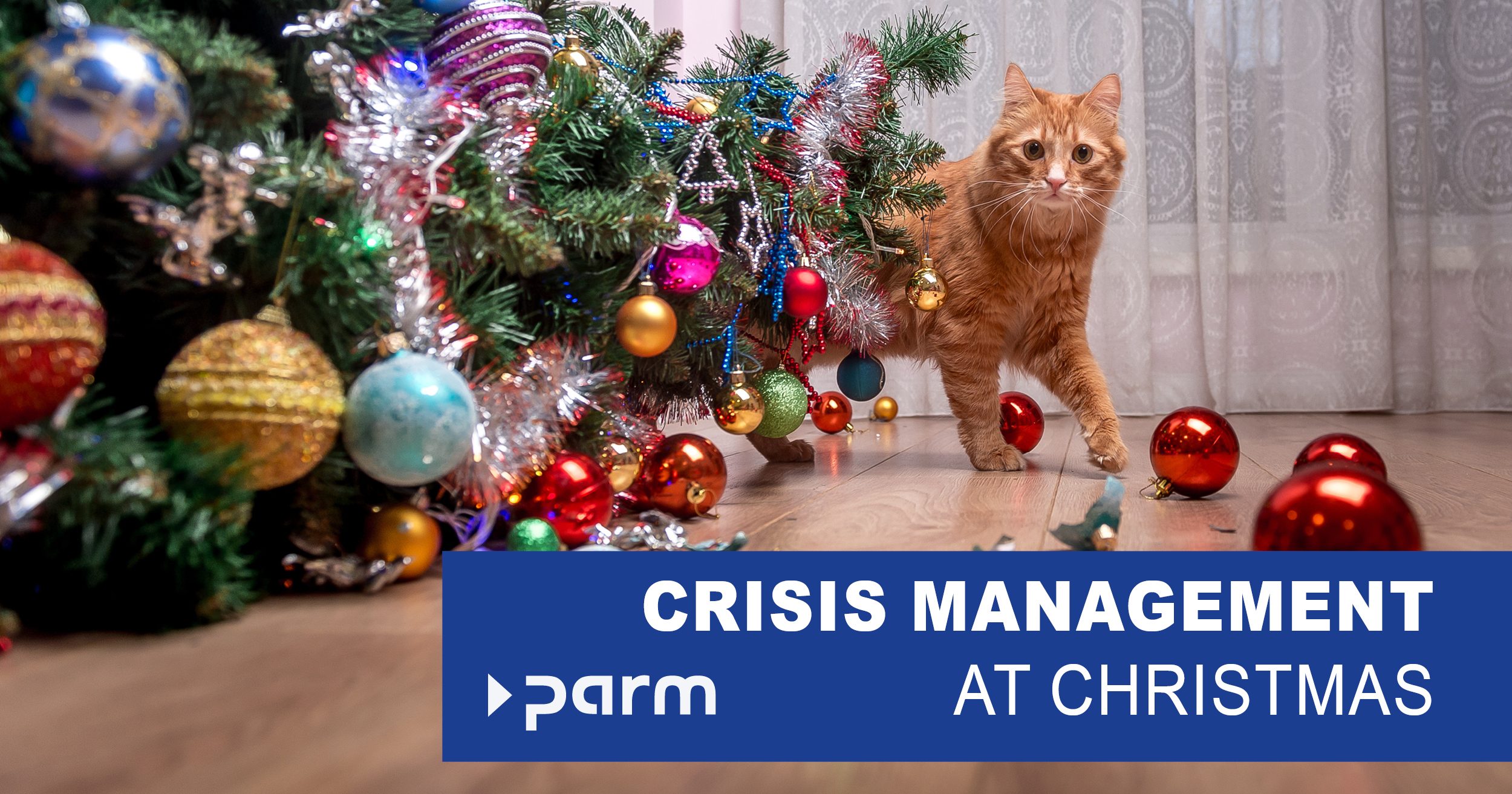
The scenario: The Christmas tree is up, the ornaments are sparkling, and the family is thrilled. But your cat takes too much pleasure in the colorful decorations, and before you can even react, all the Christmas magic comes crashing down to the floor because of the cat’s wild play.
Just like a Christmas tree that isn’t standing on a stable base, projects with shaky foundations can also collapse sooner or later—and often faster than you might think.
The solution:
- Stabilität prüfen: Sorgen Sie dafür, dass der Standfuss des Weihnachtsbaums oder das Fundament Ihres Projektes von Anfang an solide ist. Klare Ziele, Rollen und Ressourcen helfen dabei, Projekte ohne grössere Schwierigkeiten umzusetzen.
- Act quickly: If something goes wrong, act immediately. You can’t save a fallen tree by counting the number of broken balls. It is much more important to fix the most urgent problem first before getting down to the details. So first set up the tree properly and clear away the broken pieces. The decorations come afterward.
- Improvisation allowed: Sometimes the emergency nail (or adhesive tape) is the pragmatic solution to make the Christmas tree shine again or to save the project after all. Before the whole Christmas celebration unravels, embrace the chaos, improvise, and look forward to sharing the story as a funny memory next year.
Scenario 3: "The fairy lights are not working - technical faults"
The incident: You've spent hours draping the fairy lights perfectly around the tree. But when you switch them on? Nothing! The tree stays dark, and your mood teeters on the edge of collapse.
Technical problems are like defective fairy lights – they often occur at the most inopportune moment and pose a huge threat to the success of a project. Yet many technical problems are often easy to fix or can be avoided altogether from the outset if you just remember to check the function of the fairy lights in good time before draping them around the tree.
The solution:
- Debugging first: Stay calm and check the problem systematically. With older fairy lights in particular, there is often only one single bulb to blame. Even if it's no fun to check every bulb in a chain of lights, it can save your evening. In project management, this means finding the cause before taking radical measures.
- Have a backup ready: A backup - in this case perhaps a second string of lights - can save the day, even if the non-functioning string of lights has to be taken down first and the new one draped properly.
- Use teamwork: Checking the light bulbs or replacing a string of lights are tedious jobs. So why not invite the family to find or rectify the fault together? Can't find the cause, but don't have a backup? Then ask family or friends if they could lend you a replacement. The team can also provide support in the event of difficulties at work. Brainstorming sessions with the team, for example, often help to solve problems more quickly. Your laptop breaks down just before an important presentation because the battery is flat. Then a colleague can surely lend you their charger.
Scenario 4: "The festive meal burns - escalation in the kitchen"
The incident: The perfect Christmas dinner should be the highlight of the evening. But the goose stays in the oven too long, the roast is dry, and the gravy? A salty nightmare.
Projects can also "burn" if risks are ignored or control mechanisms are forgotten. Such escalations are often the result of a lack of monitoring or communication.
The solution:
- Check early on: Regular interim checks are the be-all and end-all - for both food and project management. Status updates or monitoring the Christmas roast with a roasting thermometer, for example, prevent nasty surprises.
- Re-using resources: Has the goose been burnt? Perhaps you can conjure up something else from the edible leftovers, such as an improvised Christmas burger. In project management, this means thinking creatively and finding alternative ways.
- Managing escalation: Instead of panicking or burying your head in the sand, it often helps to show a sense of humor: "Who would have thought we'd be ordering pizza tonight?" can make for a laugh and defuse the situation.
Scenario 5: "The wrong gift - if the requirements were unclear"
The scenario: Instead of the necklace she wanted, your partner finds a frying pan under the Christmas tree? In cases like this, the disappointment can be immense, and the root cause analysis begins: Who failed to understand or communicate the wishes correctly?
In project management, too, misunderstandings regarding requirements often lead to disappointed stakeholders—whether it’s a product with the wrong features or a campaign that misses the mark.
The solution:
- Involve stakeholders early on: If you had asked beforehand, it would have been clear that "something nice" is not necessarily a frying pan - no matter how good you thought your idea was. Clear communication and early feedback are therefore crucial to avoid misunderstandings.
- React flexibly: Can the pan perhaps be swapped for jewelry after all so that your partner is happy? In project management, agility, and good change management are often the key to successfully implementing projects even when requirements change.
- Use prototypes: If you had perhaps browsed through a catalog or clicked through an online store together beforehand, there would probably have been no unpleasant surprises. An MVP (minimal viable product) also helps to clarify expectations early on in projects.
Conclusion
Christmas disasters may seem frustrating at first glance, but they offer an excellent opportunity to hone your crisis management skills for projects. With good preparation, a cool head, a little flexibility, and a knack for improvisation, you can successfully overcome—or even prevent—many a crisis.
And if something does go terribly wrong, a dash of humor can help make life easier and save the mood. After all, the spirit of Christmas isn’t about perfection, but about togetherness, serenity, and joy. And who knows: maybe that improvised pizza or that crooked little Christmas tree will become your most unforgettable memory and a funny anecdote that your family will love to share for years to come.
With that in mind: Merry Christmas, and best of luck with all your projects—both professional and personal!
Find out more about the myPARM project and portfolio management software:
Would you like to get to know myPARM in a demo? Then make an appointment with us right away!