



Project Management ABC: B for Balanced Scorecard
Plan Strategic Project Management Effectively and Measure Success

In an increasingly complex business world, the ability to successfully plan, implement, and monitor projects is crucial. The Balanced Scorecard can serve as a powerful tool in this regard, measuring not only financial performance but also taking other important aspects into account. In this article, we delve into the world of strategic project management and demonstrate how the Balanced Scorecard (BSC) can serve as a guide for examining goals from various perspectives and ensuring long-term success.
What is the Balanced Scorecard?
The Balanced Scorecard (BSC) is much more than just a tool for measuring financial metrics. It is a comprehensive management method that helps companies define, measure, and achieve their strategic goals. Originally developed by Robert Kaplan and David Norton, the BSC expands the traditional financial perspective to include three additional perspectives: customers, internal processes, and learning and development. When linked to key performance indicators, targets, and actions, these perspectives provide a balanced view of corporate performance and contribute to the targeted management of projects and the organization as a whole. The Balanced Scorecard thus serves as a kind of dashboard for corporate strategy, making it clear to employees what matters, which goals they should use as a guide when making decisions, and what actions they must take to achieve those goals.
The four standard perspectives of the Balanced Scorecard
1. Financial Perspective:
The financial outlook remains of fundamental importance, as it reflects a company's financial health and success. Here, goals are measured using key metrics such as revenue, profit, return on investment, and return on equity.
2. Customer Perspective:
This perspective focuses on customer needs. Customer satisfaction, loyalty, market share, and service quality are typical metrics, as are, for example, recommendations and complaints.
3. Internal Process Perspective:
This section examines the internal processes and procedures that enable the company to meet customer expectations and achieve its financial goals. Efficiency, quality, innovation, rework rates, and process lead times are typical key performance indicators.
4. Learning and Development Perspective:
This perspective focuses on the continuous improvement and further development of the company, thereby enabling an assessment of the internal potential being utilized. Employee competencies, training, innovation, and knowledge management are relevant aspects in this context.
Additionally used perspectives in the Balanced Scorecard
5. External Factors:
It is important to take external factors into account in the Balanced Scorecard, as they can have a significant impact on a company’s performance. By taking into account external factors from the economic, environmental, social, and technological spheres, companies gain a more holistic view of their strategic direction and can better respond to changes in the external environment. This helps ensure that the Balanced Scorecard can be used effectively as a tool for corporate management.
6. Sustainability:
Sustainability is playing an increasingly important role in corporate management and reporting. The Balanced Scorecard (BSC) and Global Reporting Initiative (GRI) reporting are two approaches that help companies define, measure, and communicate their sustainability goals.
Typically, a sustainability-oriented Balanced Scorecard also incorporates environmental, social, and governance (ESG) metrics.
Companies can use the data they collect in the sustainability perspective of their Balanced Scorecard to prepare their GRI report.
In particular, the four standard perspectives of the Balanced Scorecard are closely interlinked and, when used in the traditional way, support a company’s overall strategy. Each perspective offers a unique viewpoint that helps ensure that goals and actions are considered from different angles.
Application of the Balanced Scorecard in project management
Project management should also be aligned with corporate goals to ensure that the right projects—ones that support the corporate strategy—are implemented. In this way, the BSC provides a clear structure and a balanced, holistic approach to the strategic alignment and implementation of projects. By applying BSC concepts to project goals and measures, we ensure that projects are not viewed in isolation but fit into the context of the company’s overall strategy. Here’s how the BSC can be applied in project management:
1. Strategic project selection and alignment:
The BSC helps identify the projects in the project portfolio that best align with the company's long-term strategy. By aligning project objectives with the BSC's perspectives, projects can be evaluated to ensure that they support the company's goals.
2. Clear goal setting and performance measures:
The BSC enables the precise definition of project objectives in each of the perspectives. For each objective, appropriate performance metrics are defined that make the project’s progress and success quantitatively measurable. This provides a powerful tool for monitoring and evaluating project performance.
3. Balanced project planning:
By examining projects from various perspectives, BSC ensures that project planning is well-balanced. In addition to financial considerations, customer satisfaction, process optimization, and team development are integrated into the planning process. This results in a holistic approach to project planning and implementation.
4. Transparency and communication:
In addition, the BSC facilitates communication and improves transparency in project management. All stakeholders—including team members, managers, and external partners—can use the BSC to understand the project goals and how they contribute to the company’s overall strategy.
5. Early identification of deviations:
Through continuous monitoring and measurement, deviations from project objectives can be identified early on. This makes it possible to take corrective action in a timely manner to get the project back on track and minimize negative impacts on the overall strategy.
The use of the Balanced Scorecard in project management thus creates a framework that helps companies view projects not in isolation, but as part of a broader strategy. This promotes the effective use of resources, optimal results, and ultimately ensures the success of both individual projects and the company as a whole.
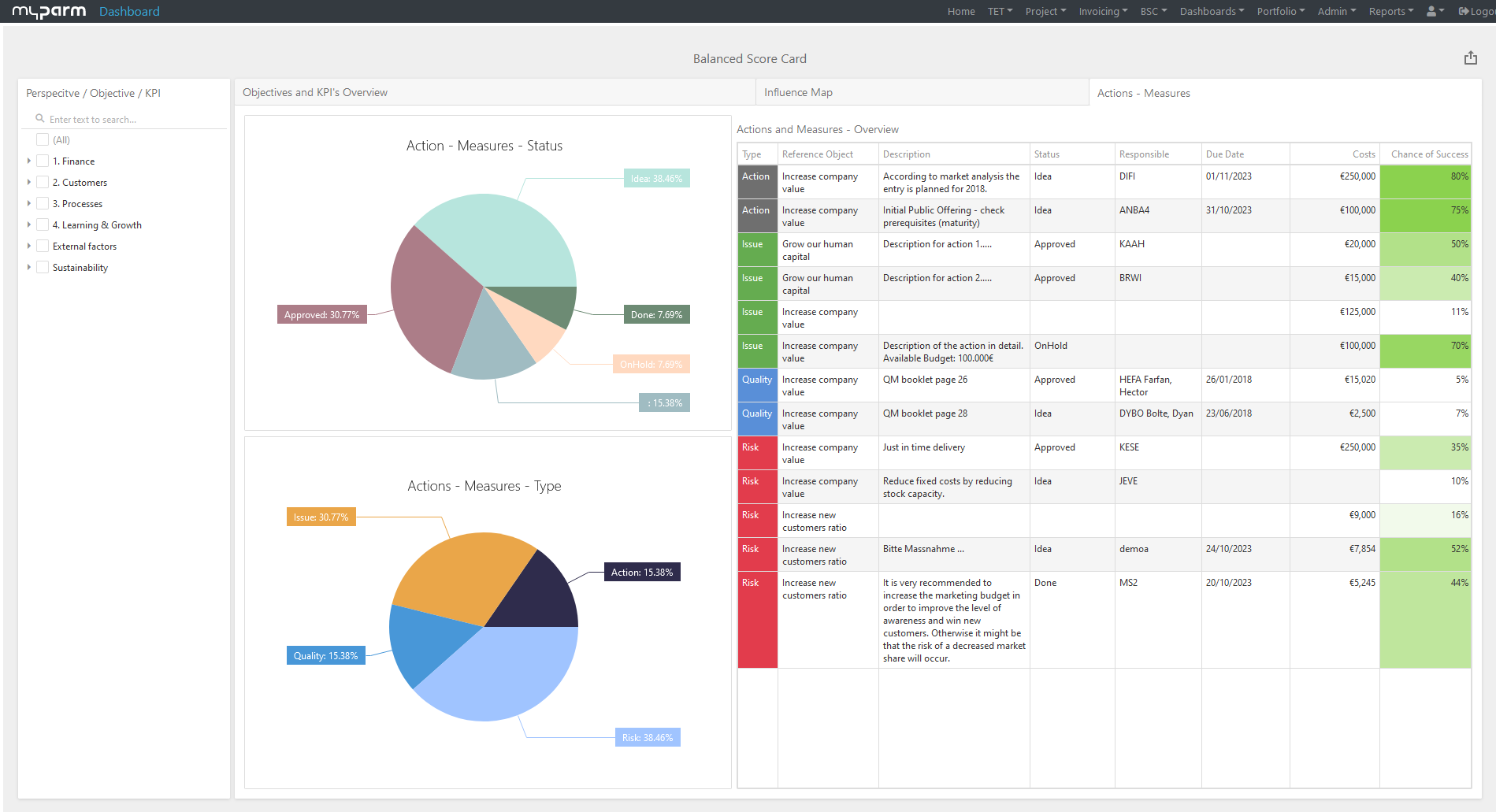
Connection of project goals with BSC perspectives
Linking project objectives to the perspectives of the Balanced Scorecard helps to view projects holistically and align them with corporate strategy. Each of the four BSC perspectives offers a unique view of the project objectives, fostering a comprehensive understanding of a project’s value and impact. At the same time, each perspective serves as a guide to ensure that not only are short-term project goals achieved, but that the projects also contribute to the company’s long-term success and strategy.
1. Financial Perspective:
From a financial perspective, project objectives aim to evaluate and measure the project’s contribution to the company’s profitability and financial stability. This could include increasing revenue, reducing production costs, or improving return on investment. The financial perspective thus helps identify projects that have a direct impact on company profits and thereby support financial goals.
2. Customer Perspective:
From this perspective, project goals are defined to meet customer expectations and needs. This could be a specific product that should be developed by the end of a project, or it could refer to increasing customer satisfaction, improving product quality, or offering customized solutions. By focusing on the customer’s perspective, projects ensure optimal alignment with market demand, strengthen customer loyalty, and guarantee long-term value creation.
3. Internal Process Perspective:
From this perspective, project goals focus on the efficiency and optimization of internal processes. This may include shortening process lead times, minimizing bottlenecks, or improving production quality. By improving internal processes, projects help boost the company’s overall performance and reduce costs.
4. Learning and Development Perspective:
From this perspective, goals focus on the continuous improvement of the team’s skills and competencies. Projects could, for example, aim to provide training, foster talent, or establish innovation processes. This perspective helps ensure that the team is able to successfully overcome the challenges of the project and the future business environment by constantly evolving, learning new skills, or employing innovative approaches.
Creating a Balanced Scorecard for a project
- Defining Project Goals: Identify the project’s main goals in terms of finances, customers, internal processes, and learning and development. These goals should be specific, measurable, achievable, relevant, and time-bound (SMART).
- Mapping to BSC Perspectives: Assign each project objective to one or more BSC perspectives. Ensure that each perspective is appropriately addressed and that all relevant aspects are covered.
- Establishing Performance Metrics: Define clear performance metrics for each objective. These should be quantifiable so that the project’s progress toward each objective can be measured.
- Setting Target Values: Set target values for each performance metric that you aim to achieve. These serve as benchmarks for evaluating the project's progress.
- Developing Initiatives and Actions: Identify the specific initiatives, actions, or measures needed to achieve the project goals. These should be described in detail and outline the steps planned to achieve the goals.
- Checking for Balance: Ensure that the project BSC is balanced and that all four perspectives are adequately represented. An excessive emphasis on any one perspective can lead to imbalances that undermine overall success.
- Alignment with company BSC: Compare the project BSC with the company's BSC to ensure that project goals align with the overall company strategy.
- Communication and Acceptance: Clearly communicate the project BSC you have created to everyone involved in the project, including team members, managers, and stakeholders. Ensure that the team understands the significance of the BSC and can identify with it.
- Continuous Monitoring and Adjustment: Continuously monitor the project’s progress using the BSC performance metrics. If necessary, adjust the BSC to reflect changes in the project’s dynamics or in the company’s strategy.
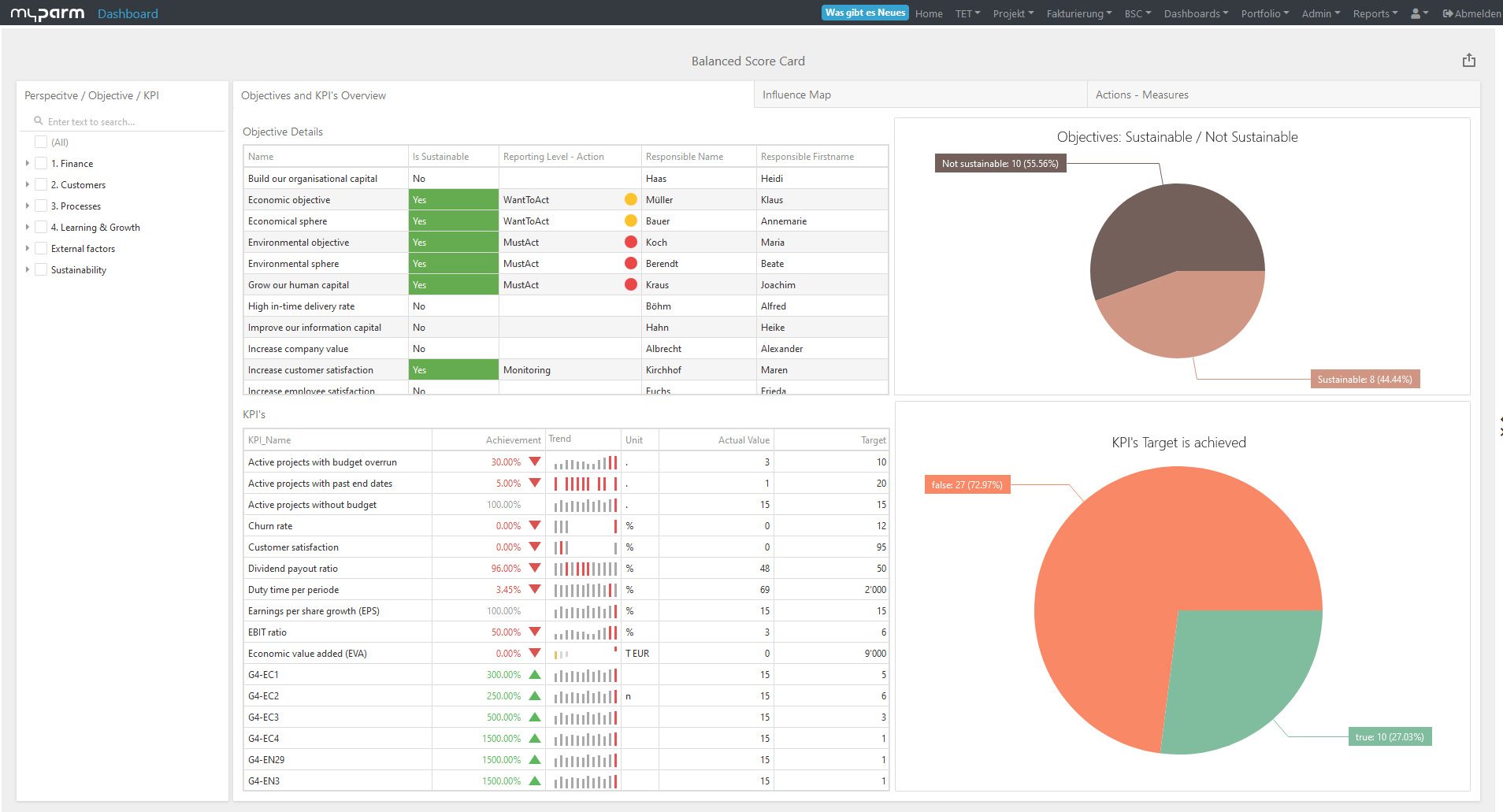
Measurement and evaluation of project performance
Measuring and evaluating project performance is a crucial step in ensuring that the objectives of the Balanced Scorecard (BSC) are met in project management. By regularly monitoring and analyzing performance metrics, the project team can respond to deviations in a timely manner and ensure the project’s success.
- Data Collection and Analysis: Continuously collect data relevant to BSC metrics. This may include financial metrics, customer satisfaction ratings, process lead times, and progress in employee development. Analyze the data to identify trends, patterns, and potential deviations.
- Comparison with Target Values: Compare the collected data with the target values previously defined in the project BSC. This shows whether the project is on track to achieve its goals or whether adjustments are needed.
- Early Detection of Deviations: One of the strengths of the BSC lies in its ability to detect deviations early on. If data suggests that project goals will not be met, corrective actions can be taken in a timely manner to get the project back on track.
- Root Cause Analysis: When deviations occur, it is important to analyze their causes. Is the problem due to internal processes, unexpected market changes, or other factors? This analysis makes it possible to identify the steps needed to resolve the situation.
- Communication and Reporting: The BSC helps ensure that the status of project performance is regularly communicated to all relevant stakeholders. Sharing information about progress and challenges promotes transparency and helps mobilize support and resources.
- Adjusting the Project BSC: Based on the insights gathered and the performance evaluation, adjustments can be made to the Project BSC. This may include changes to target values, actions, or priorities to ensure that the BSC continuously reflects the project’s progress.
Adaptation and flexibility: Benefits of the Balanced Scorecard in a dynamic environment
The business world is subject to constant change, which can affect companies and their projects. In this context, the Balanced Scorecard plays a key role in project management, as it enables companies to respond flexibly to changes without losing sight of their overall strategy.
- Dynamics of the Business Environment: Projects can be influenced by external factors, such as market changes, technological breakthroughs, or regulatory requirements. The BSC helps organizations account for these changes by encouraging them to analyze the impact on their project objectives and adjust them as necessary.
- Adjusting Performance Measures: If circumstances change, the performance measures originally established may no longer be relevant. In such cases, companies can use the BSC to define new measures that are better suited to the changed situation while still supporting the overall strategy.
- New Opportunities and Risks: Applying the BSC in project management enables companies to identify new opportunities and assess risks that arise during the project’s lifecycle. This allows projects to be expanded into potentially lucrative areas or enables a proactive response to potential obstacles.
- Agility and Iteration: The BSC can also be seamlessly integrated into agile project management approaches. Agile teams can adjust their goals and actions accordingly as they work iteratively and respond to customer feedback. The BSC serves as a guideline for these adjustments.
- Consistency and Overall Strategy: Despite its flexibility, the BSC emphasizes the importance of consistency in the overall strategy. Adjustments should always be made with the company’s long-term goals in mind to ensure that short-term changes do not lead to a distortion of the strategic direction.
Challenges and best practices in applying the Balanced Scorecard in project management
While the Balanced Scorecard offers numerous advantages in project management, there are also some challenges to consider. Successful implementation requires a deliberate approach and the application of best practices to achieve the best results.
Challenges:
- Complexity of Measurement: Selecting appropriate performance metrics can be challenging, as not all project goals are easily quantifiable. Creativity and strategic thinking are required to identify indicators that adequately reflect progress.
- Data Availability and Quality: The accuracy of BSC measurements depends on the availability of high-quality data. Companies must therefore ensure they have reliable data sources to conduct accurate performance evaluations.
- Alignment with corporate objectives: Harmonizing the project BSC with the overarching corporate BSC can be a challenge. It is important to ensure that projects not only pursue their own objectives but also contribute to the overall strategy.
Best practices:
- Clear Communication: Ensure that all project stakeholders understand the goals and principles of the BSC. Clear communication fosters acceptance and commitment among all team members.
- Employee Engagement: Involve the team in the BSC development process. This enhances their understanding of the importance of the goals and fosters collaboration during implementation.
- Ongoing Training: Train employees on how to use the BSC and the metrics. This will enable them to interpret data correctly and independently identify measures to improve performance.
- Monitoring and Adjustment: The BSC requires continuous monitoring and, where necessary, adjustment to changing conditions. Regular evaluations help identify deviations and adapt the BSC to changes in an agile manner.
- Focus on relevant objectives: Make sure the project BSC is balanced and not overloaded with too many objectives. Therefore, focus on the objectives that have the greatest impact on the project’s success.
BSC and agile project management: Synergy between structure and flexibility
Combining the Balanced Scorecard with agile project management approaches may seem paradoxical at first glance, since the BSC emphasizes structure and planning, while agile methods require flexibility and adaptability. Nevertheless, these two approaches can be effectively integrated. Here are a few tips on how that might look:
- Agile Principles and BSC Perspectives: Agile principles such as continuous improvement, close collaboration, and a focus on customer satisfaction can be easily integrated into the BSC. In the financial perspective, for example, short-term financial goals could be adapted to the fast-paced requirements of agile iterations. The customer perspective can be strengthened through ongoing customer feedback. Internal processes could be optimized through the use of agile methods. In contrast, the learning and development perspective emphasizes the continuous development of the team’s skills, which is a central aspect of agile methods.
- Flexibility in Implementation: The BSC can serve as a flexible framework in agile projects. While a project’s specific goals and actions evolve in an agile manner, the BSC remains a guide for aligning efforts with strategic goals. The BSC perspectives thus provide a holistic view and help ensure that agile adjustments align with the company’s overall strategy.
- Measurement and Adjustment: Agile project teams can also use the BSC to measure progress and continuously assess whether agile adjustments are aligning with the desired strategic outcomes. The BSC also supports retrospective analysis to determine which adjustments lead to better results.
BSC in project portfolio management: Strategic alignment and prioritization
Project portfolio management involves selecting, prioritizing, and managing projects to ensure that they support a company's overall strategy. In this context, the Balanced Scorecard plays a key role in selecting the right projects and optimally aligning the portfolio.
- Strategic Selection and Alignment: The BSC provides a clear structure to ensure that projects align with the various perspectives of the corporate strategy. Financial, customer-oriented, process-related, and development-related objectives can be incorporated into the portfolio to ensure that projects deliver the desired value.
- Prioritization and Resource Allocation: The BSC enables informed prioritization of projects within the portfolio. The strategic objectives and expected results defined by the BSC can serve as guidelines for efficiently allocating resources to the projects that contribute most to the objectives.
- Impact on the Project Portfolio: The BSC allows for a better assessment of the impact of projects on the overall portfolio. This enables projects to be evaluated based on their contribution to the various BSC perspectives, making it easier to make strategic decisions about which projects to accept, retain, or reject.
- Ongoing Review and Adjustment: The BSC also supports the continuous review of the project portfolio. If the corporate strategy changes or new opportunities arise, existing projects can be reevaluated using the BSC, or new projects can be added based on the BSC criteria.
The future of the Balanced Scorecard in project management
The Balanced Scorecard has established itself in the world of project management as an extremely valuable tool that helps companies set strategic goals and measure project success. However, while the basic principles of the BSC are timeless, we believe its future will be shaped by innovation and further development.
- Integration of Technology and Data Analysis: Advances in technology are enabling better data collection and analysis. As a result, technologies such as artificial intelligence, business intelligence systems, and data analytics will increasingly be used in the future to create a BSC, in order to gain meaningful insights into project performance and trends.
- Real-Time Performance Measurement: The BSC will evolve toward real-time performance measurement, enabling companies to monitor project progress and track the current status at any time. This allows for rapid responses to changes and more agile project execution.
- Integrating Sustainability and CSR: The future of the BSC in project management will place greater emphasis on social, environmental, and ethical aspects. Incorporating sustainability and corporate social responsibility (CSR) into the BSC will help companies demonstrate their responsibility toward society.
- Personalized and Adaptive BSC Approaches: The BSC will also continue to evolve to support personalized and adaptive approaches. Depending on the type of project, the industry, and the company’s goals, we believe that BSC concepts will be customized in the future to ensure maximum relevance and effectiveness.
- Integration of Agile and Hybrid Approaches: As agile methods continue to gain prominence, the BSC will be incorporated more flexibly into project management to integrate agile approaches. Hybrid approaches may emerge in which the BSC provides structure and direction, while agile methods are used for implementation.
- Artificial Intelligence for Decision Support: Artificial intelligence will increasingly help support data-driven decisions in project management. AI-powered algorithms can provide recommendations for project decisions based on BSC data.
- Integrating the BSC with Other Frameworks: The BSC is increasingly being integrated with other frameworks and methods, such as Design Thinking or Lean Six Sigma. This enables a comprehensive approach to project management that combines various methods.
Conclusion
The Balanced Scorecard strategically links goals with concrete project outcomes, thereby creating clear direction, transparency, and effective performance measurement, which makes it a valuable tool in project management as well. It enables companies to view projects not only in isolation but as an integrated part of their overall strategy, thereby promoting success in a holistic manner.
The myPARM project management software enables you to use a Balanced Scorecard in project management. With features for defining project objectives, performance metrics, and target values, myPARM allows for the seamless creation and management of the BSC. Through real-time data analysis, transparent communication, and flexibility in customization, myPARM helps your company strategically align and successfully implement projects, while the software simultaneously provides a clear overview of overall success.
Find out more about the myPARM project and portfolio management software:
Would you like to get to know myPARM in a demo? Then make an appointment with us right away!