



How to choose the right project management software
A guide to help you find the right software

The range of software for project management is huge and there are countless providers. From simple solutions that are essentially only suitable for task planning to comprehensive overall packages that offer, for example, resource management, time recording, controlling and reporting in addition to pure project management, there is everything a project team could wish for. However, this wide choice also has a downside, because it makes it difficult to decide on the best project management software for one's own team. In this way, the selection and implementation of suitable software becomes a project in its own right.
Have you decided to introduce a new project management software, e.g. because project management in Excel is too inefficient for you? Then you will find a short guide here to help you select the right project management software.
7 steps to success with the right software
1. Analyze current status & define requirements
As a basis for the next steps, you should take the time to analyze the current status of your project management.
- How are projects currently planned and controlled?
- Which processes must be followed, which could be improved?
- Where can or should a new software offer support?
- Where are difficulties? What is currently already working optimally?
Talk to the members of your team about this as well, as they often have other points of view to contribute. Invite them to describe current project management issues, use cases, and areas for improvement. Ask what the approach to a project is and which functions are essential. In this way, you can compile a catalogue of functions and requirements. In order for this catalogue not to become too extensive, you should concentrate on the requirements that are really essential and prioritise them. This creates a list with which you can compare the various software solutions in the following.
2. Clarify technical requirements
Of course, your existing technical infrastructure also plays an important role in selecting the right project management software solution for you. It’s best to determine—before you even start your search—whether the software should be installed on your own hardware (on-premise) or whether it can be used in the cloud. You should also consider which interfaces with existing software are necessary. For example, if the project management software needs to use data from Excel or your ERP system, or transfer project-specific data to other systems, you should know this in advance.
The capacity of your IT department is also an important factor here—can your IT team make the necessary adjustments to the software themselves, and do they have the capacity to handle the software’s administration? Or would it be better for the software vendor to handle this, and for you to subscribe to the software on a Software-as-a-Service (SaaS) basis?
3. Product Research
You can now look for suitable solutions with your catalogue of requirements and the technical prerequisites. In this respect, comparison portals and product studies can also be helpful. You can, for example, compare software on projektmagazin.de or the Barc study and filter according to the criteria that are particularly important to you. If your project management team works according to a specific methodology or standards, such as PRINCE2, you can also specifically look for software that supports this. You will then find what you are looking for at SERVIEW, for example
4. Test software
Once you’ve found a few suitable solutions that match your specific requirements, you can schedule initial presentation meetings with the vendors to ask any questions you may have and put the potential solutions to the test through pilot projects. Testing under real-world working conditions is important, as this is the only way to determine whether your team members can work effectively with the software.
Pilot projects are particularly helpful in this regard: The project management software can be configured to meet your specific needs in terms of processes, terminology, input forms, and other displays, thereby significantly increasing user acceptance of the new software. By importing existing data or mapping out specific projects, the software can be tested under realistic conditions following an initial brief training session. Be sure to set aside sufficient time for this phase (approximately two to three months) and involve future key users of the software in the testing to gather sufficient information early on about future user acceptance and to ensure that the preferred software solution is also user-friendly. You may also discover during this phase that none of the options are suitable for your requirements or that you have given the highest priority to the wrong requirements. In these cases, you should revise your requirements specification and start your product research again.
5. Estimate implementation effort and costs
Before you decide on a solution, you should estimate the costs that you will incur with the respective option. For this, you can obtain a binding offer from the manufacturer. In addition, you should clarify how quickly the respective software could be introduced in your team, i.e. from when the whole team can start working productively with it. This includes not only the time needed by the manufacturer or your IT department to adapt the software and provide interfaces, for example, but also the time needed for training your employees. Often, the manufacturer can also help you with an initial estimate with his experience or can even give you a guarantee for the costs and implementation time.
6. Selection
Now compare the different options and decide on a solution. In this step, too, you should involve all central persons in order to make the best possible decision and to increase the acceptance of the new software in advance.
7. Implementation
Once a decision has been made, the next step is to implement the software. To ensure that the introduction does not fail, you should now focus on strengthening user acceptance. If you have already included the most important users in your decision in advance, you have already made a great deal right here. Nevertheless, you should clearly demonstrate to all users how the new software facilitates their everyday work and what its advantages are. For this purpose, it can be useful to define key users who are trained particularly intensively in the use of the software. These key users can then support and motivate all other users.
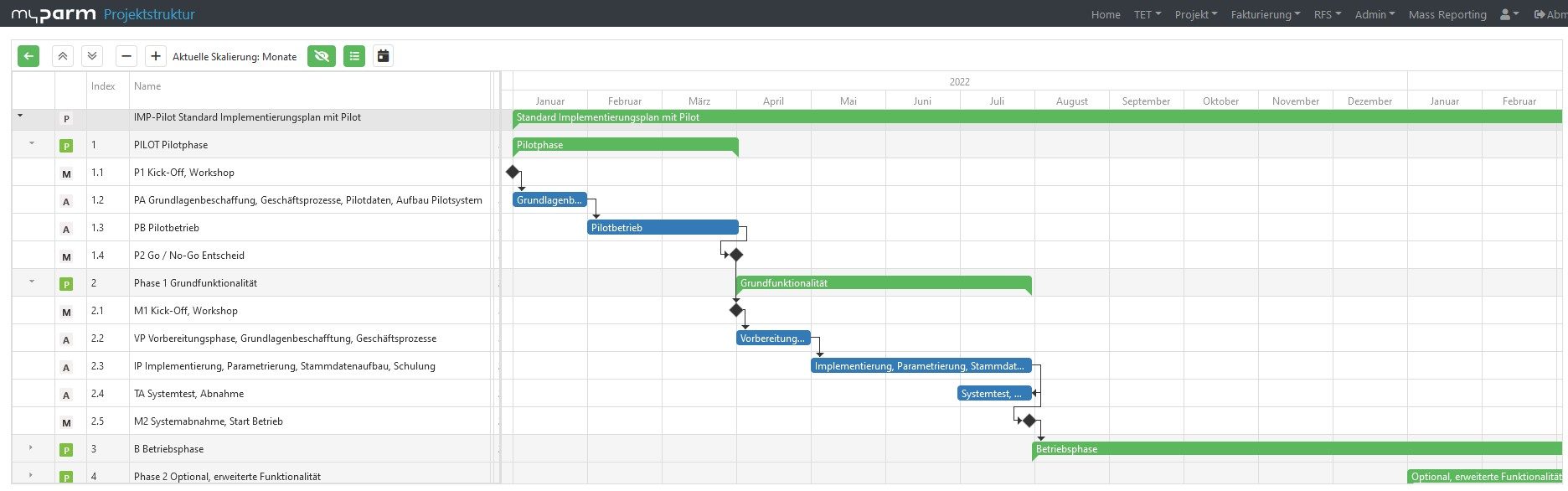
The project management software myPARM
Every department within a company has its own specific requirements. This often leads to the creation of siloed solutions within a company—solutions that are used in one department but make no sense in others. In such cases, it may be advisable to choose a comprehensive solution as your new software or to integrate the new solution into your existing system landscape. myPARM is one such comprehensive solution that not only offers various modules in the area of project management—which you can combine to suit your individual needs—but, with its numerous interfaces, can also be flexibly integrated into your existing systems. In addition, myPARM includes numerous supporting functions, such as document management, risk and opportunity management, and personalization.
If you initially only need a less comprehensive solution, you can use individual modules of the software and keep others hidden. Thanks to myPARM’s high flexibility, the software can then grow with your needs. If you wish, you can even use management software or the new BI module in addition to the project management functions.
More about the project management software myPARM:
Would you like to get to know myPARM in a demo? Then make an appointment with us right away!