

Project Management ABC: S for SCRUM
Efficient Teamwork with SCRUM: Principles, Roles, and Ceremonies
Flexibility and efficiency are often crucial to a project’s success. This is where SCRUM comes into play—an agile framework that was originally developed for software development but is now used in many industries. SCRUM helps teams break down complex projects into manageable, incremental steps to achieve results faster and more effectively.
What is SCRUM?
SCRUM is an agile framework that helps teams develop and deliver complex projects in small, manageable steps. It is based on iterative and incremental processes that enable continuous improvement and adaptation. Scrum is primarily used in software development, but it has also gained prominence in other fields.
Scrum was developed in the early 1990s by Jeff Sutherland and Ken Schwaber. Both were looking for a flexible and effective approach to overcoming the challenges of software development. Their goal was to create a framework that would help teams respond more quickly and effectively to changing requirements and complex projects.
The term "SCRUM" itself comes from rugby and refers to a formation in which the team works closely together to move the ball forward. This metaphor illustrates SCRUM's collaborative and iterative approach, in which the entire team works together to successfully complete a project.
The three pillars of SCRUM
Scrum is based on the idea of carrying out a project in recurring iterations (sprints) rather than planning everything in advance. In each iteration, insights are gained that are used in the next cycle. Therefore, three pillars form the foundation of Scrum:
- Transparency: All aspects of the process must be visible and understandable to everyone involved. Transparent processes and goals foster trust and collaboration within the team.
- Inspection: Regular reviews of work and progress are crucial for identifying and resolving problems early on. SCRUM ceremonies such as the Daily SCRUM and Sprint Review provide the appropriate opportunities for this.
- Adaptation: Based on the results of the inspection, the team continuously adapts its way of working. This enables a rapid response to changes and new insights.
The roles in the SCRUM team
In SCRUM, there are three key roles, each with specific tasks and responsibilities: the SCRUM Master, the Product Owner, and the development team. These roles are clearly defined to ensure that all aspects of the project are effectively managed and implemented.
1. SCRUM Master
The Scrum Master is responsible for ensuring that the process is followed. He acts as a process coach, mentor, and facilitator. As a servant leader, they serve the team by removing obstacles. They also promote continuous improvement, lead Scrum ceremonies, and train team members in the principles of Scrum. In doing so, they do not exercise any control over the project team’s work content and do not issue instructions; rather, they simply ensure that the team can work productively and is protected from outside influences, so that a productive workflow can be maintained.
2. Product Owner
The Product Owner is responsible for the project’s content and serves as the primary point of contact for all matters related to product development. As such, the Product Owner manages requirements by defining and prioritizing product requirements in the Product Backlog. The Product Owner thus acts as a liaison between the development team and the stakeholders. In this way, they ensure that the product meets customer expectations and needs. They develop and communicate the product vision and ensure that the team works toward long-term goals. In addition, the Product Owner makes decisions regarding the scope and priority of the work to be implemented in each sprint.
3. Developer
The development team is responsible for implementing the project’s requirements. Such a team should be multidisciplinary (cross-functional). This means it should consist of professionals with diverse skill sets who work together to carry out the tasks. Therefore, the team usually consists of three to nine members—small enough to minimize communication overhead, yet large enough to cover all necessary skills. This is important because the development team is self-organized and decides independently how best to complete the upcoming work. At the end of each sprint, this team delivers a finished, potentially shippable product increment. In addition, the team regularly reflects on its own work processes and results in order to continuously optimize them.
Collaboration among the roles is crucial to the success of a Scrum team. The Scrum Master ensures that processes run smoothly, the Product Owner defines clear goals and priorities, and the development team implements them efficiently. Through regular communication and collaboration, they ensure that the product is continuously improved and adapted to customer needs.
Artifacts in SCRUM
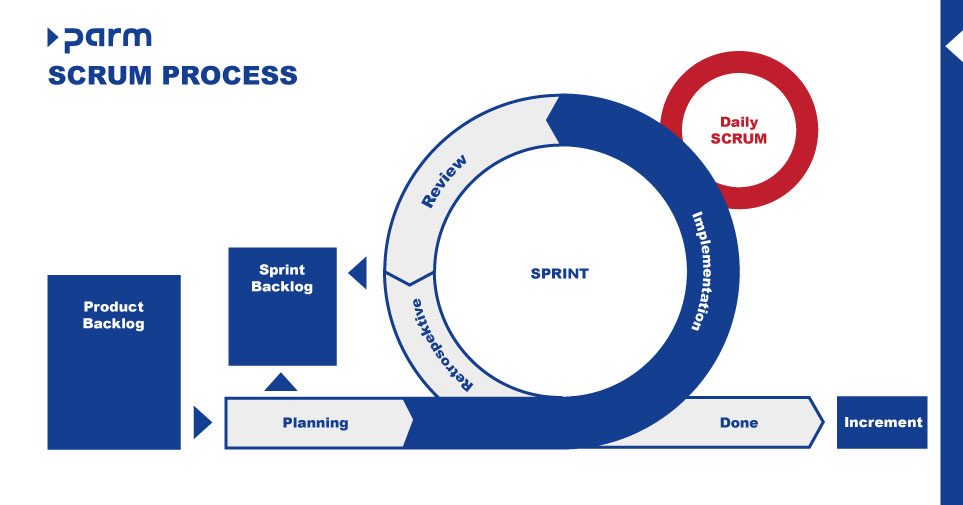
In SCRUM, there are three key artifacts that support the development process and ensure that all stakeholders are kept informed about the current status and progress. These artifacts are the product backlog, the sprint backlog, and the increment.
1. Product Backlog
The product backlog is an organized list of requirements and tasks necessary for the development of the product. It includes all features, improvements, and bug fixes to be implemented in the product. Unlike a requirements catalog in the traditional project management the product backlog is dynamic, meaning that new requirements are continuously added, and existing ones can be modified or removed. Items are prioritized according to their importance, based on business value and stakeholder requirements. The top items with high priority are typically described in clear detail, as they are to be implemented in the near future, while items further down the list will only be specified in more detail over time.
2. Sprint Backlog
The Sprint Backlog is a list of tasks that the development team plans to complete during a sprint. It is created at the beginning of each sprint during the Sprint Planning Meeting and is based on the highest-priority items in the Product Backlog. The Sprint Backlog therefore contains only the tasks that the team intends to complete in the current sprint to achieve the sprint goal. It is supplemented by a plan for how the tasks will be implemented, which involves breaking them down into subtasks. It can be adjusted and updated as needed during the sprint to ensure that the sprint goal is achieved.
3. Increment
An increment is the result of all the tasks completed during a sprint, plus the increments from previous sprints. It thus represents another step toward the final product and demonstrates that the product becomes more valuable and comprehensive with each sprint. Regardless of whether an increment is actually put into production later, it must be functional and potentially shippable. At the end of each sprint, the increment is presented and reviewed during the Sprint Review to ensure that it meets the requirements and provides valuable input for further development.
The artifacts in Scrum are closely interlinked and, together, play a crucial role in the project’s success. The Product Backlog provides the foundation for the work in the Sprint Backlog, and the completion of this work results in a new increment. This structure enables iterative and incremental development, which promotes flexibility and continuous improvement.
Events in the SCRUM framework
Unlike traditional project management, agile project management does not involve predefined phases, but rather cyclical iterations. In Scrum, these iterations are called sprints and form the core of all Scrum projects. Each project consists of several sprints, which should last no longer than one month and are designed to achieve a defined goal. Each sprint includes the following events: Sprint Planning, Daily Scrum, Sprint Review, and Sprint Retrospective. In addition, there is the Backlog Refinement meeting. These meetings, also known as ceremonies, serve to ensure that the team works together effectively, that progress is regularly reviewed, and that both the work and the product are continuously improved.
1. Sprint Planning
Sprint Planning is used to plan the work for the upcoming sprint. During this meeting, the team determines which items from the Product Backlog will be addressed in the next sprint. The meeting lasts a maximum of 8 hours for a 4-week sprint, though the duration should be correspondingly shorter for shorter sprints. In this meeting, the goals for the next sprint are set by the Product Owner presenting the highest priorities from the backlog and explaining the sprint goals based on them. The team then discusses and selects the backlog items it can implement during the sprint. Afterward, it creates a detailed plan for how these items can be turned into working increments.
2. Daily SCRUM
The Daily Scrum is a short daily meeting to review progress and update the plan for the next 24 hours. The meeting is often referred to as the Daily Standup, since it’s usually held standing up and should last no more than 15 minutes. In practice, three questions have become standard that each team member should answer during the meeting:
- What have I done since the last Daily Scrum?
- What will I do before the next Daily Scrum?
- What obstacles am I facing?
3. Sprint Review
At the end of each sprint, a sprint review is held, during which the increment is presented and the team receives feedback from stakeholders. Based on the insights gained during the sprint, the feedback received, and potential changes in the market, the Product Backlog is then adjusted. This meeting should last no more than 4 hours for a 4-week sprint and is a very important event because it facilitates direct communication between the developers and the stakeholders.
4. Sprint Retrospective
In accordance with the principle of review and adaptation, the team reflects on the past sprint during the sprint retrospective and identifies opportunities for improvement for future sprints. During the meeting, which lasts a maximum of 3 hours, the team analyzes the positive aspects of the past sprint (What went well?) as well as the challenges and problems (What didn’t go well?). Based on this, action plans are developed to improve work methods, collaboration, and processes.
5. Backlog Refinement (also Backlog Grooming)
The only Scrum meeting that does not follow a defined structure is the Backlog Refinement Meeting. Its purpose is to update the Product Backlog and ensure that the items are well understood and prioritized. Existing items are reviewed and updated. Items with higher priority are described in greater detail to prepare them for future sprints, and the effort required for the new or updated items is estimated.
Conclusion
Scrum offers a proven methodology for managing complex projects by enabling teams to work more efficiently and flexibly. Through its clear structure of roles, artifacts, and ceremonies, Scrum promotes a transparent and collaborative way of working that is focused on continuous improvement. This not only leads to higher productivity and greater satisfaction within the team but also to better and faster results for customers and stakeholders. Whether you’re a newcomer or an experienced user, SCRUM offers valuable approaches and tools to successfully overcome the challenges of modern projects.
If you'd like to experience the benefits of SCRUM in your own project management, the myPARM project management software could be the ideal solution. With numerous features designed to support agile SCRUM processes, myPARM is a user-friendly platform that helps your team collaborate efficiently and effectively.
Find out more about the myPARM project and portfolio management software:
Would you like to get to know myPARM in a demo? Then make an appointment with us right away!